


Business Results
Built for apparel complexity
Apparel fulfillment is different. Thousands of SKUs. Size and color variants. Piece-level picking. Returns that flow backward through the same aisles. Your pickers walk. Our system moves shelves instead.
Challenges
Why apparel warehouses automate now
The operational realities that make apparel fulfillment expensive
Products
Robotics solutions driving operational performance


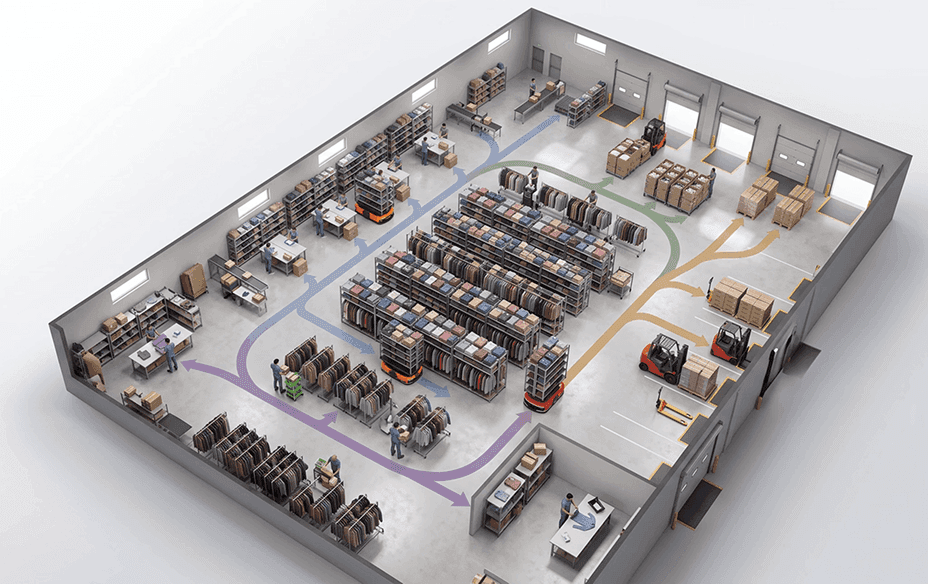
Apparel warehouse simulation
See how robotics could work in your warehouse.
Explore a 3D simulation based on real apparel orders. Follow inventory through picking and sorting, and see how throughput and order backlog change during a collection launch.
Scale apparel fulfillment. Spread the cost.
36-60
months
Spread the cost of warehouse automation through monthly payments instead of a large upfront purchase. Keep more capital available for inventory, new collections, and seasonal needs.
Available for US-registered businesses.
Subject to approval.
Solutions
Software delivering measurable impact


CONTACT US
Deus Robotics selects, combines, and orchestrates robots from different models to help you achieve the results you're after.

The workflow
Deployment without disruption
Your warehouse keeps operating throughout
Use cases
How apparel brands use automation across different fulfillment models



Benefits
Why choose Deus Robotics
for apparel automation
One contract, one responsible party, built for apparel fulfillment complexity.
Find the bottleneck limiting your fulfillment capacity


FAQ
Common questions about apparel fulfillment automation
What is apparel fulfillment automation?
Using robots and software to automate picking, sorting, and returns. Operators stand at stations. Inventory towers move to them. No walking.
How does Shelf-to-Person work?
Towers arrive at operator stations in sequence. Operator picks items. Robot takes tower away. Next tower arrives. Picking speed increases because every minute is productive picking time, not walking time.
Is it suitable for fashion e-commerce?
Yes. Apparel is one of the best-fit markets for Shelf-to-Person robotics because of piece-level picking, high SKU counts, and peak-season pressure. The payback period is typically 1–2 years.
How much picker walking time disappears?
Walking can be 50%+ of a picker's shift in manual warehouses. With Shelf-to-Person, robots bring shelves directly to operators at picking stations, reducing walking time and freeing up more time for order picking.
Does automation help with returns?
Returns are 20-30% of apparel orders. Each must be inspected and put back on sale. With S2P, returns inspected at station are placed in next arriving tower. Back on sale in minutes.
Can you integrate with our WMS?
We integrate with the WMS you already run through a documented REST API. The integration scope is confirmed after reviewing your WMS documentation. Your WMS remains the system of record. If you switch WMS providers later, the new system can connect to Deus RMS while retaining the robot control layer.
How long does deployment take?
Equipment production and delivery typically runs a few months. Integration and training run in parallel. Exact timeline after concept phase and WMS API review.
Do we need to stop operations during installation?
No. Inventory migration runs in waves. Warehouse keeps shipping. Shelving operates manually before robots switch on.
What happens to our warehouse team?
Pickers become station operators doing the productive part of the same job. Peak season scales without temporary labor armies. Most clients grow into capacity rather than cut heads.
How do we start?
Request a consultation. We discuss your operation, volumes, peak challenges, and building layout. Determine if a concept study makes sense.