A $5M Investment in Robotics: The Story of Paul Pikulin, Who Turned a Childhood Passion into a Multimillion Business

Paul Pikulin jokes that he has basically had a computer since the day he was born. His father is a radio engineer and his mother is a computer programmer, so no wonder the boy followed his parents to design websites at the age of 7; he was making games and managing a team of game developers when he was 13, and earned his first million before he reached his 25th birthday.
Paul, 32, is a successful entrepreneur and co-owner of WhaleApp, one of the leading gaming holding companies. He is also driving innovation in robotics through Deus Robotics, a company pioneering advanced robotic solutions. Paul has invested more than $1 million of his own funds into the project, aiming to become a technology partner for major logistics companies.
dev.ua is telling his story.
Computers from birth with limited access to games
Paul was an ordinary child with the only difference that he has had access to a computer since his early childhood. His father built a computer long before they became accessible in stores. “He started providing Internet access services when I was six,” says Paul Pikulin. His mother was a computer programmer, and he chose to follow a similar path.
Pikulin designed his first website when he was 7 at the request of his friend’s father. This was his first paid job ever — he earned $20. He then had more customers: he did all programming stuff in HTML and created graphic elements in Paint.
The young computer programmer learned to use Visual Basic for Windows when he was 10.
He confessed, however, that his access to the computer was restricted by his parents, a situation typical for teenagers.
“They could allow me to use the computer for 15 minutes a day (doctor recommendations). The computer was protected by passwords, but I always managed to unlock it. My parents would take the cord away, but I always knew where to get a spare one. They would check the display temperature, so I had to finish using the computer well before my parents got home to make sure the display was already cool,” says Paul smiling.
His parents have never restricted his access since he started making good money.
Paul admits he had earned from games by detecting bugs, getting and exchanging game artefacts for money.
“I had enough gaming money to buy a car by the age of 13,” he says.
But the teenager preferred investing in server equipment and active development of his gaming universe.
Paul was also interested in artificial intelligence. He designed an award-winning license plate recognition system when he was 15. He even made a commercial offer to the government. Paul Pikulin later studied at the Faculty of Cybernetics and launched his first business early in his career, operating in a highly competitive market environment.
Playing offline business and noble online business games
Paul became a businessman when he was 19. “My fellow student and I opened a computer club. I wanted to create the most comfortable space for gamers, he says. — I invested $70,000 I had honestly earned from games.”
But the 2008 crisis had devastating effects: Paul decided to sell his club because of lack of success of his offline business and hard-hitting racketeer raids. The selling price was nearly five times lower than his investment. That was his first failure.
He then decided to pursue his childhood dream — to create his own game. He raised $30,000 of investment and designed With Fire and Sword game with other two game developers in his own apartment. Paul admits that the game was not successful, and the project failed even though he had invested additional $60,000 in an attempt to improve it. This was his second failure.
The businessman did not fall into despair: he refocused on social media. Together with another software developer he worked with at that time, he created an app for VKontakte, which was then getting popular. They made Restorator, a photo editing app, which became viral and extremely popular in 2010.
“We sometimes had up to 200,000 downloads a day. It was a VKontakte record high,” says Paul.
With up to 1 million unique users per day, the guys earned around $30,000 per month from advertising. Pikulin was not going to stop there: his team created more than 20 apps for more than 25 million users.
The giddy success made Paul’s team noticed by Plarium, then the largest game developer in the social media. The company bought all advertising on Paul’s services in 2010 and later suggested that he designs his own holding-based games. This is how War of the Worlds and Battle of Zombies were born and became best-selling.
Paul tells that Plarium founders sold the business, bought some new studios and created a new holding company on the wave of 2017 success offering Pikulin to become a business partner. This is when WhaleApp was founded. Today, the company operates five studios across multiple countries, with its headquarters in Israel.
Two Pauls and a million-dollar project
Having made enough money to start making his childhood dream reality, Paul decided to focus his carrier on robotics in 2017.
“I have been interested in artificial intelligence since I was a kid, but it was hard and expensive to do a large-scale project. However, making robots got many times cheaper due to less costly components manufactured in China while I was in the game development business,” he says.
Pikulin and his partner Pavlo Sheliazhenko, who previously worked in Google head office, created Deus Robotics by bringing together the top robotics engineers and software developers.
Pikulin chose construction but made a mistake — the industry was not ready for his expensive assistants.
“I guess we are ahead of our time. I believe in construction robots: they will replace human finishing work in a few years,” says Paul.
Nova Post was the first company to show interest in the robots.
“They had a specific need to automate their warehouse processes, and we agreed to meet it,” says Paul.
This is how the sorting robot prototype first appeared: it could define destinations using a barcode and sort the parcels.
“We are happy to cooperate with Deus Robotics. Prompt service is among key advantages of Nova Post, so we are introducing automation and robotics in our workflow, speeding up the sorting processes and, hence, parcel delivery,” Nova Post explains.
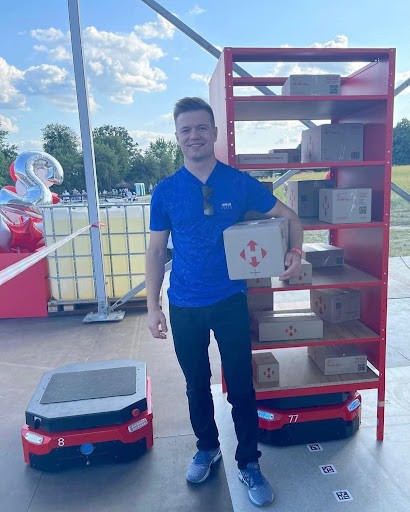
Paul Pikulin, a personal archive photo
Nova Post is currently testing two types of Deus Robotics robots. The first type are transporting robots. It is programmed to approach the rack with cargoes at a specific time and to transport the whole rack to the operator simplifying their work considerably. NP is also testing sorting robots. They automatically distribute parcels by destinations and put them into the right compartment or bag.
Paul has already invested more than $1 million in his robotics business. Robot engineers and software developers are based in the company’s main office. The company currently employs 11 engineers and 6 software designers.
“I think we will expand our operations dramatically next year. We have a laboratory where we make our robots. And there is an office for our programmers. Remote work is not an option because of the need to test robots,” says Pikulin.
Deus Robotics built five robots last year and 40 robots this year; Paul expects to increase production up to 1,000 smart assistants in 2022.
To achieve this goal, the businessman seeks to scale up production to 500–2,000 robots per month. According to Pikulin, the current demand for Deus Robotics devices is 1,000 pieces.
“We are currently in discussions with 10 of the largest companies in the market. While no contracts have been signed yet, active project negotiations are underway, which may take up to six months. We believe adoption would be faster if businesses had a clearer understanding of the value robotics can deliver,” says Paul.
Epicenter has confirmed they were in negotiations. Epicenter K Group has not yet worked with Deus Robotics. “Deus Robotics is currently preparing conceptual proposals based on our terms of reference; we’ll then consider any further cooperation,” reported the company’s press relations service. Epicenter currently uses sorting solutions from Vanderlande, but leaves open the possibility of cooperating with Deus Robots in the future.
ATB, a major food retail chain, has not yet signed contracts with Deus Robotics and is currently using third-party robotic solutions.
“We are searching for solutions that could meet our critical needs. We are conducting dialogues with Kapelou, UISLab and GreyOrange,” explained the company’s representative.
Robot plans
Pikulin has very ambitious plans for the development of his robotics business despite the long negotiations and high competition. He estimates the warehouse robotics market will grow fivefold in five years.
“We are also interested in delivery and construction robotics. But these are still emerging markets, and their development is hard and expensive. We will activate our efforts in this sector when a demand arises,” says the inventor.
He aims to build the most advanced production center, where robots will be assembled by robots.
“It will include the service center and the R&D center. We are planning to open our school to train robotics engineers. “We are currently looking for a site for our production facility and expect to launch our first mass production line next year,” explains Paul.
He needs around $20 mln for this project and is currently negotiating with large venture capital funds.
Paul also has ambitious plans for global expansion.
”We seek to develop very actively aiming the markets of Europe and Americas, and even Africa and Asia. Our spending will be higher than our revenues in the coming years if we want to increase production and sales. We are not focused on making profits as quickly as possible. Our company will be profitable in five years,” he says.
He aims to automate companies in his primary market first, and then bring proven solutions to compete with large international players.
“Our robots are now cheaper than those made in China because we are a start-up and understand that our solution has not yet been operating as long as that of our competitors. We’ll have competitive pricing and will also offer higher supplies,” says Paul Pikulin.

